
Induction bends up to 36 inches.
Two induction machines in Calgary bending carbon steel, stainless steel and alloys. Tighter radii and larger diameters than cold bending can reach.
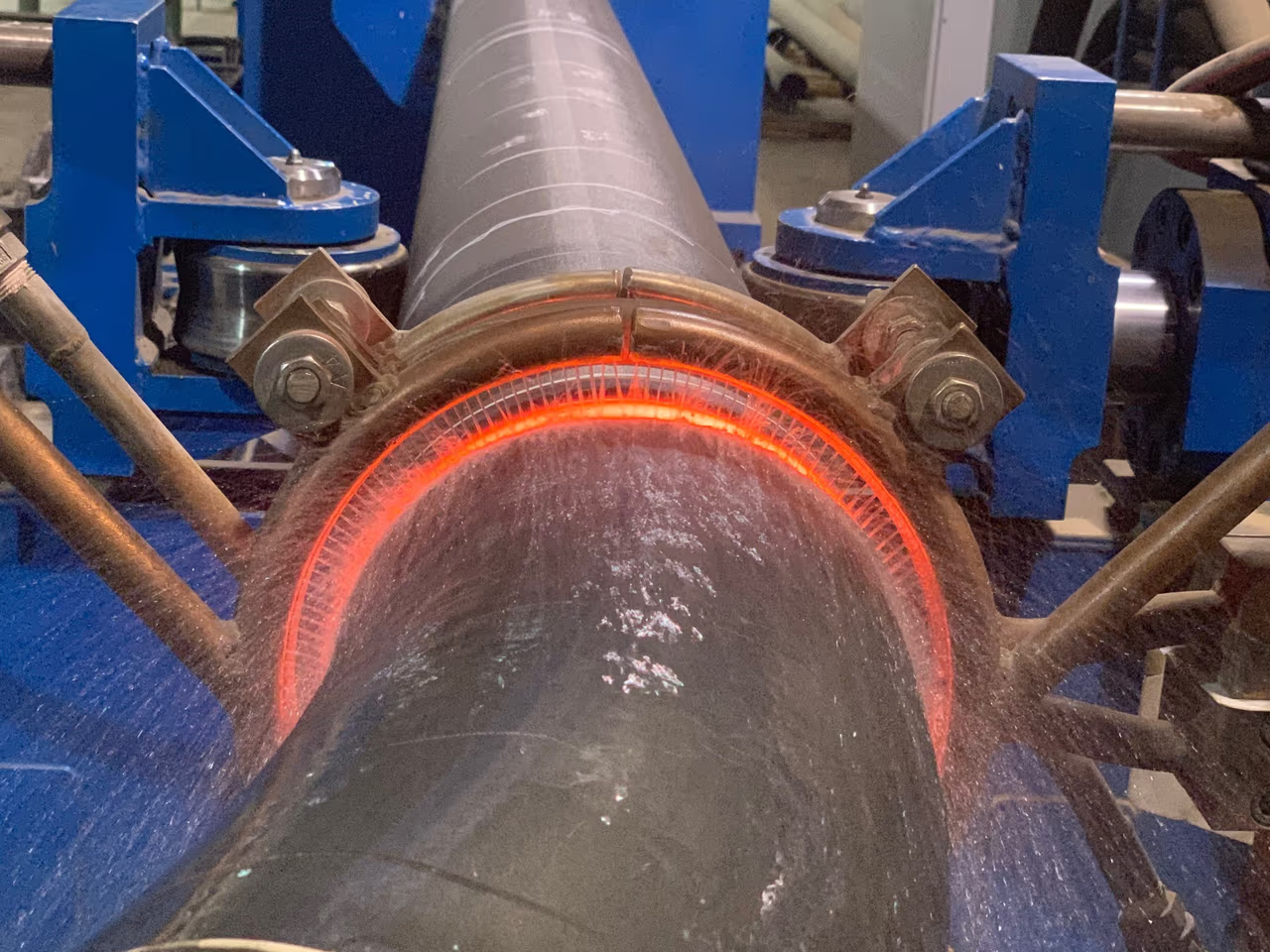
Induction bending is a hot-forming process: a narrow band of the pipe is heated by an induction coil to forming temperature, the pipe is pushed through the coil against a fixed radial arm, and the bend is quenched immediately behind the coil. Benpro induction bends carbon steel, stainless steel and alloys up to 36" outside diameter, to a maximum radius of 10 metres and angles up to 180°, at our Calgary facility, to CSA Z245.16, ASME B16.49 and ISO 15590-1.
Induction bending capacity.
| Maximum outside diameter | 36" (914 mm) |
|---|---|
| Maximum bend radius | 10 m |
| Minimum bend radius | 1.5D |
| Maximum bend angle | Up to 180° |
| Geometry | Single bends, S-bends, compound bends, multi-plane three-dimensional bends |
| Materials | Carbon steel, stainless steel and alloys |
| Machines | 2 induction bending machines |
| Post-bend heat treatment | In-house, to 680 °C, furnace 5.4 × 3 × 3.6 m |
| Codes | CSA Z245.16 · ASME B16.49 · ISO 15590-1 · PFI ES-24 · CSA Z662 |
| Documentation | Bend report, MTR, inspection records, lab results and more upon request |
Two induction machines. If your requirement sits outside these figures, send it anyway. Wall thickness, grade and geometry all move the boundary.
Four things happen at once.
The reason induction bending holds its shape is that heating, forming, quenching and measurement all happen inside a few centimetres of moving pipe.
01
Localised heating
An induction coil heats a narrow circumferential band of the pipe. Only that band is hot, so the rest of the pipe keeps its properties.
02
Forming
The pipe is pushed forward while a radial arm holds the centreline, forming the bend through the heated band.
03
Quench
A water spray immediately behind the coil cools the formed section, fixing the geometry and controlling the microstructure.
04
Verification
Angle, radius, ovality, hardness and wall thinning are checked and recorded. The report travels with the bend.
What D-ratio are you asking for?
Bend radius is usually expressed as a multiple of the pipe's outside diameter, so a "5D bend" has a centreline radius five times the OD. The lower the number, the tighter the bend, and the more the outside of the bend thins as the material stretches.
Send us the diameter and the centreline radius you need and we will confirm the D-ratio back to you, along with whether it is induction or cold bending work.
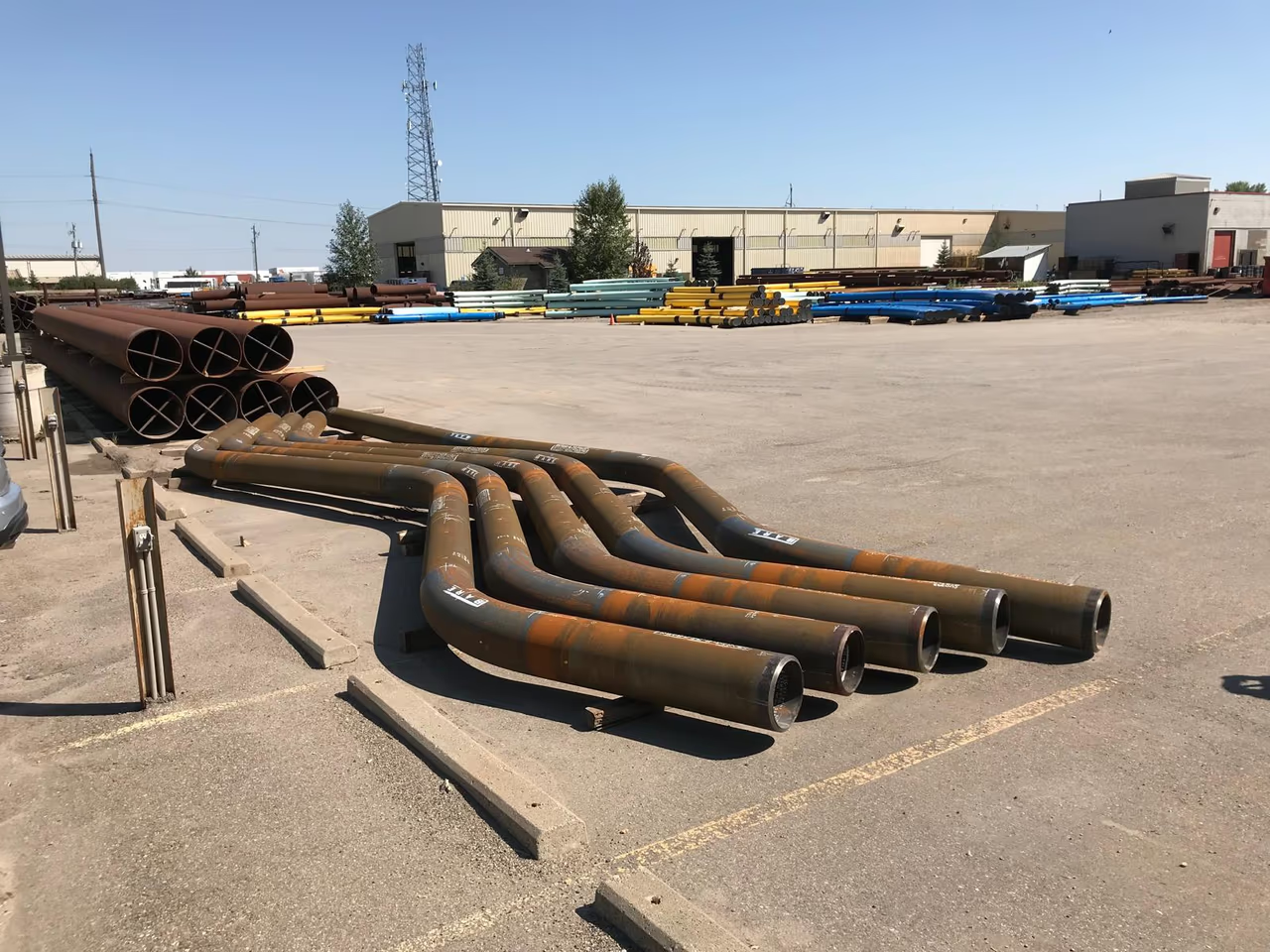
S-bends, compound bends and true 3D.
A single length of pipe can carry more than one bend, in more than one plane. S-bends can be formed on the induction benders or cold, depending on the diameter and the radius. That matters when a run has to weave through congested pipe rack, cross an existing line, or follow a right-of-way that does not care about your drawing.
Two notes on vocabulary, because buyers use "3D" to mean two different things. A 3D bend radius means a centreline radius three times the outside diameter. Three-dimensional bending means the bends sit in more than one plane. We do both. Tell us which you mean and we will confirm it back to you in the quote.
Where our induction bends go.
The questions customers ask.
What is the largest diameter you can induction bend?
36" outside diameter. The maximum bend radius is 10 metres and the maximum angle is 180°. Materials include carbon steel, stainless steel and alloys.
Induction bending or cold bending: which should I specify?
Induction bending when you need a tighter radius or a larger diameter, or when the wall is thin enough that it would ripple in a cold bend. Cold bending when the radius is generous, typically 10D and above, the diameter is 20" or less, and especially when the pipe is already coated.
How much wall thinning should I expect on the extrados?
The outside of the bend stretches, so it thins; the inside compresses and thickens. How much depends on the D-ratio, the wall thickness and the grade, because tighter bends thin more. We measure and record wall thickness on every bend and report it. If your design has a minimum remaining wall, tell us up front and we will confirm what starting wall you need to order.
What ovality can you hold?
Ovality limits are set by the governing standard for your job: CSA Z245.16, CSA Z245.17, ASME B16.49 or ISO 15590. We bend and verify against whichever applies. Ovality is measured and recorded on the bend report. If your specification is tighter than the standard, say so with the enquiry.
Is post-bend heat treatment included?
It is available in-house, in a furnace rated to 680 °C measuring 5.4 m × 3 m × 3.6 m. Whether your job needs it depends on the material and the governing code. Because the furnace is at the same facility, heat treatment does not add a shipping leg to your schedule.
Can you bend sour-service material?
Yes. We work to the CSA, ASME and ISO requirements that govern sour service, and sour-service grades are routine. Confirm the grade and category with the enquiry so we can confirm the process and testing.
Do you supply the pipe, or can I send mine?
Either. Many customers send their own material, and we bend, heat treat, blast, coat and machine it to specification. We can also source pipe. Tell us which you prefer. If you are sending your own pipe, we always ask for the MTR ahead of time so we can confirm the material is suitable for bending.
What documentation comes with the bends?
Bend reports, mill test reports, coating inspection reports where coating is applied, and lab results. The package is assembled as the job runs and ships with the steel. If you need anything else in the documentation package, tell us and we will confirm it.
What is the longest radius you can induction bend?
10 metres. That ceiling matters more often than people expect: on long sweeping directional changes, a shorter machine limit forces you either to weld two bends together or to fall back on cold bending and accept the diameter restrictions that come with it. Working in the other direction, we also reach considerably tighter radii than cold bending can. The achievable minimum depends on diameter, wall thickness and grade, so send us the geometry and we will confirm it.
Send us the diameter, wall thickness and radius.
We will respond within one business day.
Up to 36" OD
Up to 10 m radius
Up to 180°
Carbon steel · stainless steel · alloys
CSA Z245.16 · ASME B16.49 · ISO 15590-1 · PFI ES-24