
Large radius bends, cold formed.
Two cold decks in Calgary bending up to 20" outside diameter, including YJ, YJ2K, UBRA and FBE coated line pipe, to CSA Z245.17.
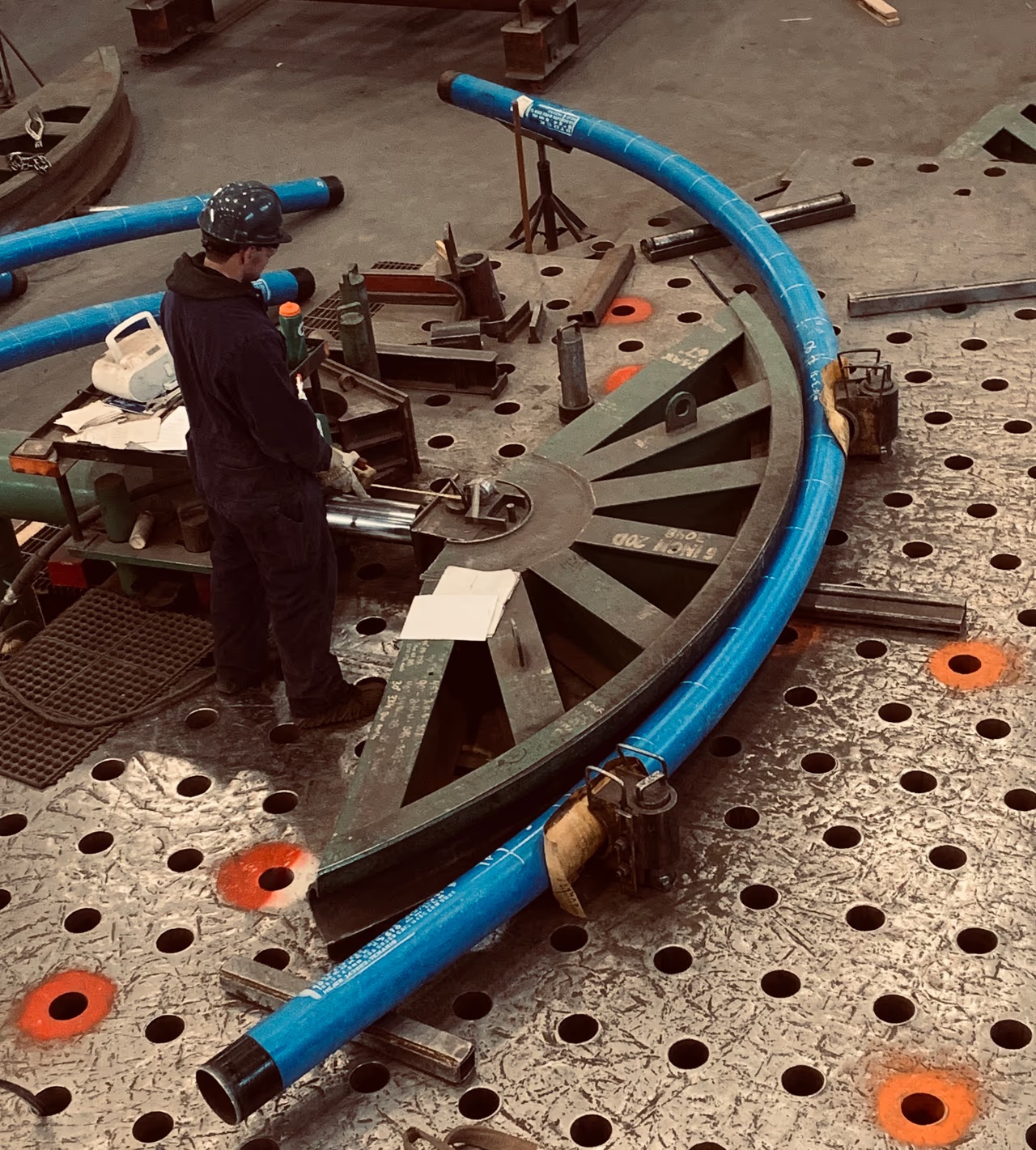
Cold pipe bending forms pipe at ambient temperature on a bending deck, without applying heat. Benpro cold bends pipe up to 20" outside diameter at our Calgary facility, to angles up to 180°, with the maximum radius limited only by the length of pipe supplied. Because no heat is applied, cold bending is the right process for pipe that is already coated (YJ, YJ2K, UBRA and FBE), and it is governed by CSA Z245.17.
Cold bending capacity.
| Maximum outside diameter | 20" (508 mm) |
|---|---|
| Typical radius | 10D and above |
| Maximum radius | Limited only by the length of pipe supplied |
| Maximum bend angle | Up to 180° |
| Geometry | Single bends, S-bends, 180° bends |
| Coated pipe | YJ · YJ2K · UBRA · FBE |
| Decks | 2 cold bending decks |
| Codes | CSA Z245.17 · ISO 15590-4 · PFI ES-24 · CSA Z662 |
| Documentation | Bend report, MTR, coating inspection where applicable, lab results |
Two cold decks. Radius, wall and coating type all interact. Send the details and we will confirm what is achievable.
The coating never sees heat.
That is the whole argument for cold bending pre-coated line pipe. An induction bend would destroy the coating in the heat-affected zone and commit you to stripping, re-blasting and re-coating afterwards. A cold bend leaves the coating intact, so the pipe goes from our deck to your right-of-way without a coating rework step.
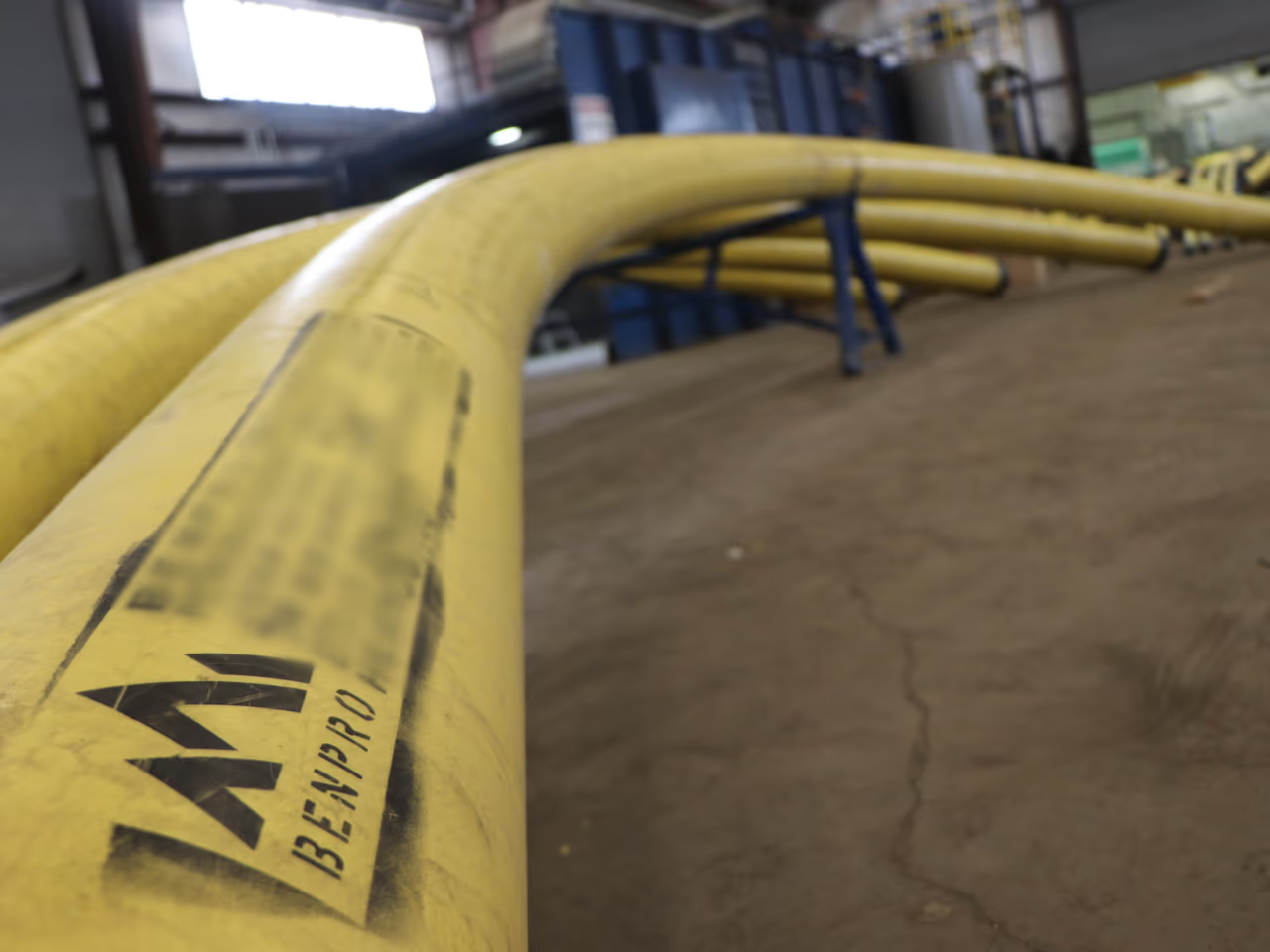
We routinely run yellow jacket (YJ and YJ2K), UBRA and fusion-bonded epoxy coated pipe. If you are bringing coated material, tell us the system and the supplier with the enquiry, because different coatings tolerate different strain.
CSA Z245.17 now governs cold bends.
Until August 2022, cold bends and induction bends both sat inside CSA Z245.11. They were then split out into their own standards: CSA Z245.17 for cold bends and CSA Z245.16 for induction bends.
For buyers, the practical consequence is in the testing. The revised standards brought changes to mechanical test requirements, hardness requirements for sour service, and Charpy test specimen sizes.
Our shop cold bends are prequalified with a destructive test bend, so you know the properties of the pipe you are installing.
Cold bending is also where the vocabulary trips people up. A "field bend" is made on the right-of-way with a portable bending machine. What we make is a shop cold bend: same principle, controlled conditions, measured and documented, delivered to site ready to install.
Common questions.
What is the largest pipe you can cold bend?
20" outside diameter. Bend angles go up to 180°, and the maximum radius is limited only by the length of pipe.
What radius can you achieve cold?
Cold bending typically works at 10D and above. If you need something tighter than that, induction bending is the right process.
Can you bend pipe that is already coated?
Yes, this is one of the main reasons to cold bend. We regularly run YJ, YJ2K, UBRA and FBE coated pipe. No heat is applied, so the coating survives the bend and you avoid a strip-and-recoat cycle.
What standard do you bend to?
CSA Z245.17, which has covered cold bends since the August 2022 split from CSA Z245.11, alongside ISO 15590-4 and PFI ES-24. Where a job also invokes CSA Z662 or a client specification, we work to those as well.
Can you cold bend for sour service?
Yes. Sour-service work is routine, and we bend to the sour-service requirements in the CSA standards. The revised standards changed hardness requirements for sour service, so confirm the grade and category with your enquiry.
Do you offer S-bends cold?
Yes. S-bends and 180° bends are both within the cold decks' range.
Coated pipe, bent and ready to lay.
Send diameter, wall thickness, radius, coating system and quantity. We will respond within one business day.
Up to 20" OD
Typically 10D radius and above
Max radius limited by pipe length
Up to 180° · S-bends
YJ · YJ2K · UBRA · FBE
CSA Z245.17 · ISO 15590-4 · PFI ES-24